By Dr. Musa Juma Saro
I grew up in a society where illness was not always understood through medicine. Sometimes, when someone became sick, the first explanation was not an infection, a medical condition or a disease. It was witchcraft.
Someone might suggest that a family member had bewitched you. Another might claim that your illness was caused by evil spirits. Before considering a hospital, people could recommend visiting a traditional healer.
I know this experience personally.
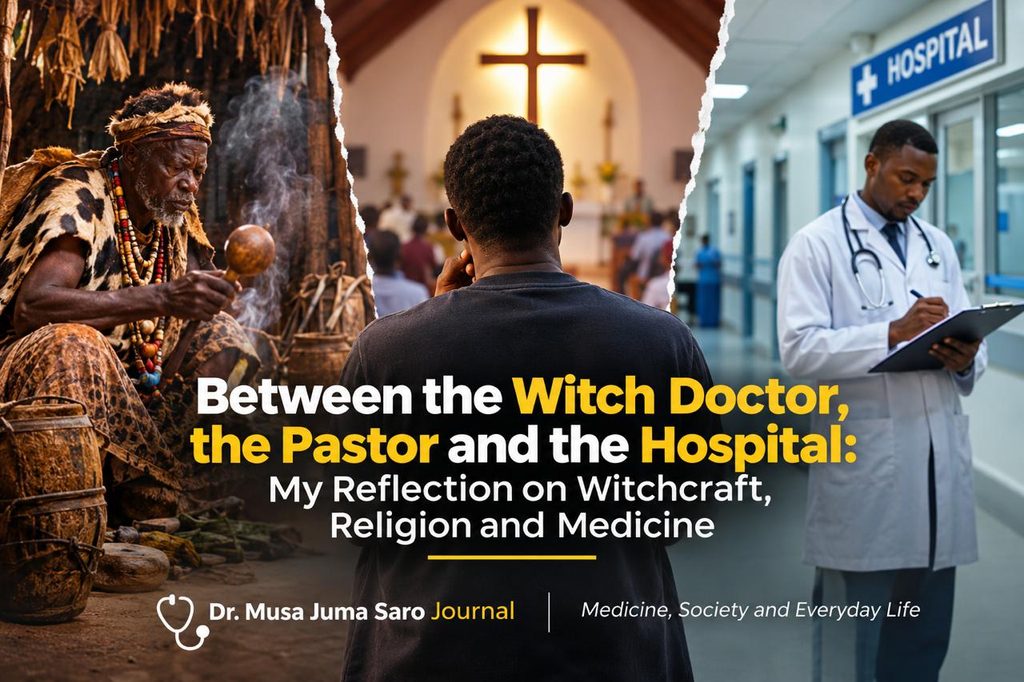
Growing up, I was taken to witch doctors. I was also taken to pastors. Like many children growing up in communities where these beliefs were deeply rooted, I experienced different approaches to understanding illness, suffering and healing.
Looking back, I find this subject particularly interesting because today I am a medical doctor.
I have moved from being someone taken to different places in search of healing to someone whose professional responsibility is to understand illness, investigate symptoms and offer medical treatment.
That experience has made me reflect on the relationship between witchcraft, religion and medicine.
When illness becomes a spiritual explanation
In many African communities, illness is sometimes understood beyond its physical symptoms.
A person who develops persistent headaches may be told that someone is responsible for their suffering. Someone experiencing unexplained changes in behaviour may be considered bewitched. A family struggling with repeated misfortunes may seek spiritual explanations.
These beliefs are part of the cultural environment in which many people grow up.
They also influence decisions about where, when and from whom people seek healthcare.
Research conducted among two rural communities on the Kenyan coast found that traditional healing remained an important part of healthcare-seeking behaviour. The study also documented how beliefs about supernatural causes of illness influenced decisions to consult traditional healers [1].
For some families, visiting a traditional healer is not necessarily a rejection of medicine. It is simply what they have been taught to do when something goes wrong.
The problem begins when an assumption about witchcraft replaces proper medical assessment.
An illness that requires investigation and treatment can become a prolonged search for someone to blame.
The place of religion
Religion is another important part of this discussion.
Growing up, I was also taken to pastors. Prayer, church services and spiritual guidance were among the approaches through which people sought healing.
I do not think faith and medicine must be enemies.
For many people, religion provides hope, meaning, community and emotional support during difficult moments. A patient can pray, attend church and still receive treatment from a hospital.
There is room for both.
However, problems arise when someone is told to abandon prescribed medication, avoid medical investigations or reject hospital treatment because their illness is considered exclusively spiritual.
Faith should not become a reason to deny someone appropriate healthcare.
A person can believe in God and still understand the importance of antibiotics when indicated, surgery when necessary, or psychiatric treatment when clinically appropriate.
What does medicine say?
Medicine approaches illness differently.
Rather than assuming that someone has been bewitched, clinicians investigate possible causes through history-taking, physical examination, laboratory investigations and other appropriate diagnostic procedures.
For example, seizures have neurological causes that require proper assessment. Persistent fever may indicate an infection. Changes in behaviour may be associated with psychiatric, neurological, metabolic or other medical conditions.
This does not mean that every illness is immediately easy to diagnose. Medicine has limitations, and sometimes investigations do not provide immediate answers.
But uncertainty should encourage further assessment, not automatically become evidence of witchcraft.
The World Health Organization’s Global Traditional Medicine Strategy 2025–2034 recognises the importance of traditional medicine while emphasising research, safety, effectiveness and evidence-based integration into health systems [2].
This is an important distinction: respecting traditional knowledge does not mean accepting every traditional explanation or treatment without scientific evaluation.
The danger of delayed treatment
One of my biggest concerns is what happens when people spend too much time searching for spiritual explanations while a medical condition continues to progress.
Consider someone with tuberculosis who is repeatedly told that their persistent cough is caused by witchcraft.
Consider a person experiencing psychosis whose family spends months moving between different spiritual institutions without seeking psychiatric assessment.
Consider a pregnant woman experiencing complications who is encouraged to wait for prayers instead of receiving urgent obstetric care.
These situations can have serious consequences.
The Kenyan coastal study by Abubakar and colleagues illustrates how cultural explanations of illness can influence healthcare decisions, including the use of traditional healing when families perceive biomedical treatment as unsuccessful [1].
The challenge is not that people have cultural or religious beliefs. The challenge is when those beliefs prevent timely access to effective medical care.
We should not ridicule our communities
As medical professionals, we must also be careful about how we approach this subject.
It is easy to dismiss people as ignorant because they believe in witchcraft or prefer spiritual explanations for certain experiences.
But beliefs are shaped by upbringing, culture, education, family experiences and access to healthcare.
For generations, some communities have relied on traditional systems because they were familiar, accessible and trusted.
If we want people to embrace evidence-based healthcare, we must communicate respectfully.
We must listen to patients, understand their explanations of illness and provide information they can understand.
A patient should not feel ashamed to tell a doctor that they first visited a traditional healer or a pastor.
That information can help us understand their healthcare journey and identify potential risks.
Can faith, culture and medicine coexist?
I believe they can, provided we understand their different roles.
Culture gives people identity and a sense of belonging. Religion can provide spiritual guidance and support. Medicine offers systematic methods of investigating, diagnosing and treating disease.
These roles can coexist without one necessarily replacing the other.
We should also recognise that not every traditional practice is witchcraft, just as not every religious leader discourages medical treatment.
There are traditional practitioners who support referrals to hospitals and religious leaders who encourage their congregations to seek professional healthcare.
Collaboration, respect and patient safety should be the priority.
My personal reflection
Sometimes I think about the journey from childhood to where I am today.
I remember being taken to witch doctors. I remember being taken to pastors. Today, I am a doctor, and my understanding of illness has changed considerably.
I do not write this article to embarrass the people who took me to those places. They were acting within the understanding of health and healing that they had at the time.
Neither do I write to attack religion or cultural identity.
I write because I believe we need to have more honest conversations about how our beliefs influence our health decisions.
We should be able to preserve our cultural identity, practise our religion and appreciate our traditions while embracing scientific knowledge.
If someone is sick, let us not spend all our time searching for the person who supposedly caused the illness.
Let us first establish what is happening medically and how the person can receive appropriate care.
You can pray for someone while they are receiving treatment. You can respect your culture without rejecting medical science. And you can have faith without abandoning evidence.
Perhaps the question we should ask ourselves is this:
How many people could receive timely medical care if we stopped treating every unexplained illness as a spiritual problem?
⸻
References
1. Abubakar A, Van Baar A, Fischer R, Bomu G, Gona JK, Newton CR. (2013). Socio-cultural determinants of health-seeking behaviour on the Kenyan coast: a qualitative study. PLOS ONE, 8(11), e71998.
https://doi.org/10.1371/journal.pone.0071998
2. World Health Organization. (2025). Global traditional medicine strategy 2025–2034. World Health Organization, Geneva.
⸻
About the Author
Dr. Musa Juma Saro is a medical doctor interested in medicine, mental health, public health and the relationship between culture and healthcare.
Dr Musa Juma Saro Journal — Medicine, Society and Everyday Life.